On SoundCloud
On YouTube
For this latest instalment in our occasional series, Elvis and the Press, we’re joined once again by our leading contributor, Gary Wells, to take a deep dive into the local coverage of Elvis’ performance in Saginaw, Michigan, on April 25th, 1977. It was the first of two non-consecutive shows to nearly 7 200 at the Wendler Arena, with a second concert added to the end of the 13 night tour in response to the demand for tickets. Reviewers for the Saginaw News observed that Elvis ‘sings as well as ever’, ‘seemed in rare form’ and ‘that he seemed to be having as good a time as his fans’.
We look beyond the familiar myths and clichés of this period to consider how Elvis’ inspired performance, captured in an unofficial audience recording, fits with what we know, or think we know, about his final months on the road, and ask whether the generally accepted narrative does justice to the reality.
Our previous episodes in this series covered Pittsburgh Pennsylvania, NYE 1976-77, and we also looked at a later show from this tour, St Paul Minnesota,April 30th, 1977.
Additional Background
If not for the bootleggers who distributed both soundboard and audience recordings primarily for the European market, much of the history of Elvis’ later career would be lost. In a pre-internet age, many of Elvis’ biographers over the years did not have access to these recordings as we do, and for better or worse, often relied uncritically on press coverage.
Many of the reviews were well-intentioned, thoughtful and honestly presented. Others were not. Some were slanted by second-hand information, factual errors, occasionally malice, and the reviewer’s own personal cynicism, disinterest, or plain bewilderment at the enthusiasm of the fans. As we’ve mentioned previously, it didn’t help that there was no special press access nor hospitality on tour; reporters and photographers had to buy their own tickets and queue with everybody else, otherwise would not be allowed into the arena.
The bootleg recording was made from within the audience, and gives us a great sense of the atmosphere in the arena. Headphones are recommended for the best listening experience.
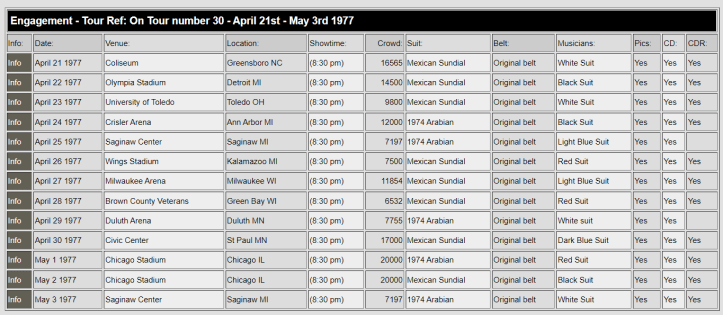
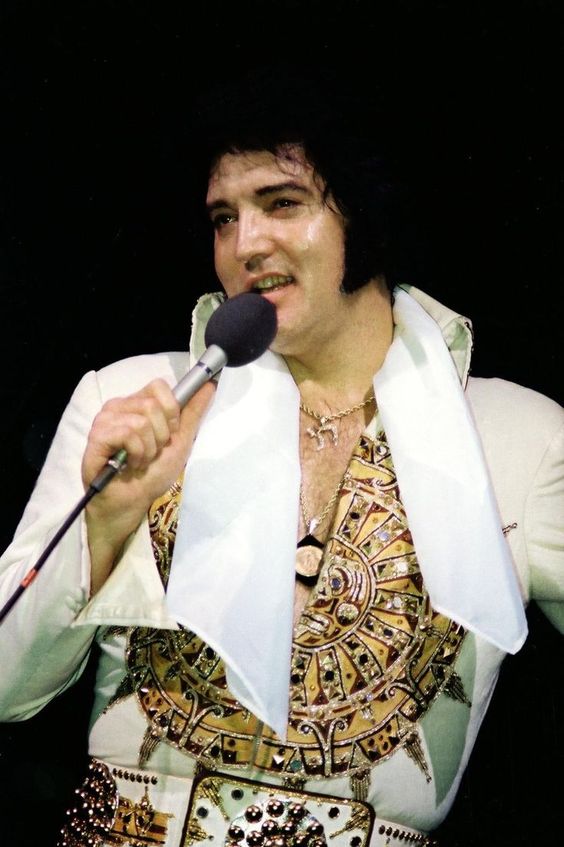
The jumpsuit of choice for both Saginaw shows was the ‘1974 Arabian’ (below left), although the ‘Mexican Sundial’ has become most identified with this period, and was apparently a little roomier and more comfortable. The ‘Arabian’ would be worn only once more after this tour, on June 18th in Kansas City, Missouri.
Find more details at the elvisconcerts.com jumpsuit index, including images and a timeline;
1974 Arabian (Ace of Spades) Suit

Our show on April 25th is fairly typical for the period, Elvis was onstage for around one hour, and there were no real surprises in the setlist. Even the lengthy band introductions and solos segment on this occasion didn’t seem to disrupt the momentum nor the sustained enthusiasm of a loud and very responsive audience.
We quote some discussion points from the reviews of both Saginaw shows here, but you can access complete transcripts of the press coverage of the entire tour at the newspaper archive at elvisconcerts.com;
April 1977 Tour: Press Transcripts
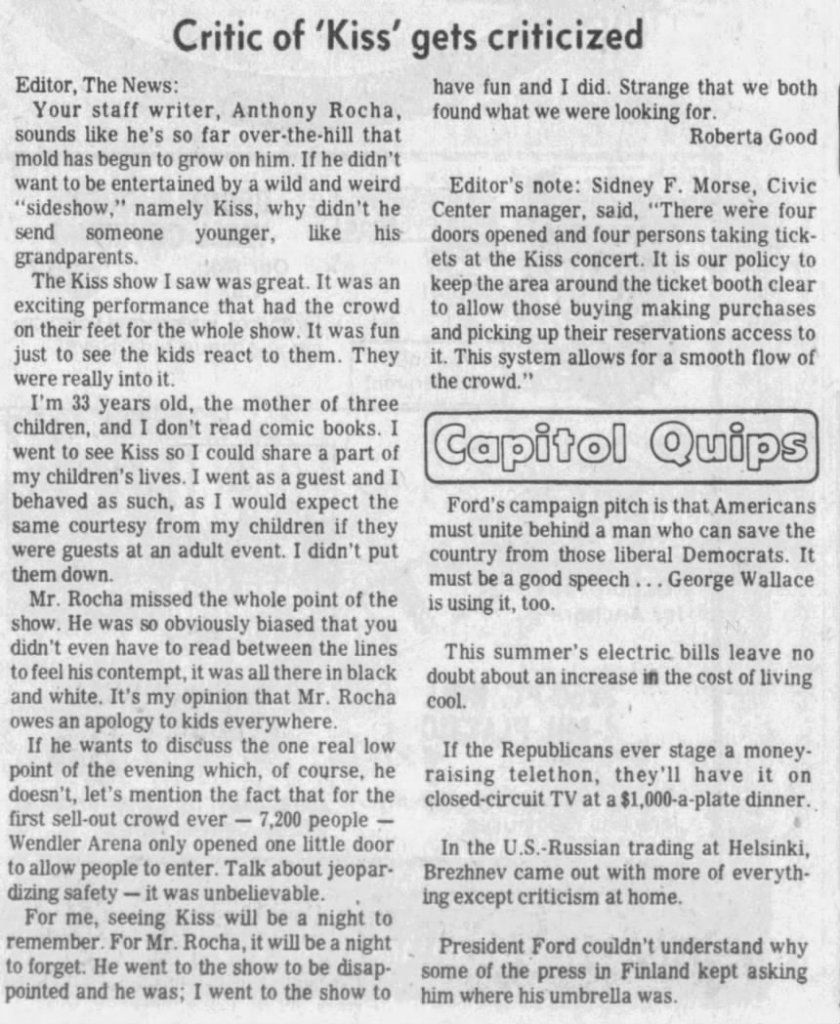
The review following the April 25th performance is credited to Anthony A Rocha and Janet Martineau. There doesn’t seem to be a great deal of information available on Anthony Rocha; he was a staff writer at the Saginaw News and he comes up in online searches relating to his writing on Elvis, Rush, BB King, Elvis Costello and Chicago, and he is the subject of some eloquent pushback against what must have been a scathing review of Kiss, live at Wendler Arena, in 1975.
Janet Martineau was an entertainment and arts writer at the paper for 42 years up until 2010 – her work is prominent online and she is on Facebook.

The review was headlined, ‘Elvis Heats Up Saginaw Crowd’;
“…Falling scarves, embattled police, screaming women, popping flash bulbs and a sneering singer an Elvis Presley concert makes. And such was the case Monday night at Wendler Arena as the legendary “King” paid his first of two visits to Saginaw.
An Elvis concert makes for an interesting time of people watching – not only watching this pulsating superstar sing and work his magic but watching the legions of fans carry on. It appears they’d kill just to snatch one of the sweaty scarves he flings at them like golden coins.
Elvis, despite being in his 40s and carrying extra pounds, still turns ’em on. He still has that animal magic, that power that with a single swivel or smirk or glare can elicit screams of “Oh Elllllllll-vis. We love you!”
He looks tired and a bit the worse for wear. He doesn’t gyrate nearly as much as he used to. His singing time amounts to less than an hour of the 2 1/2 hour concert.
But despite that, he sings as well as ever. His sense of humor sparkles. In fact, he seemed in rare form Monday – he didn’t forget any words to any songs as he has in the past…and he seemed to be having as good a time as his fans...”
The review noted the prominent hard-sell of merchandise and that ‘for prices ranging from $2 to $5 you can get big color posters of a younger Elvis, belt buckles and big buttons, pennants and necklaces,’ and that, ‘Business was booming’. They expressed some relief that Elvis hadn’t torn his pants, implying that this was otherwise a nightly occurrence, but did concede that Elvis was ‘not the hulking mass many writers would have us believe he is’.
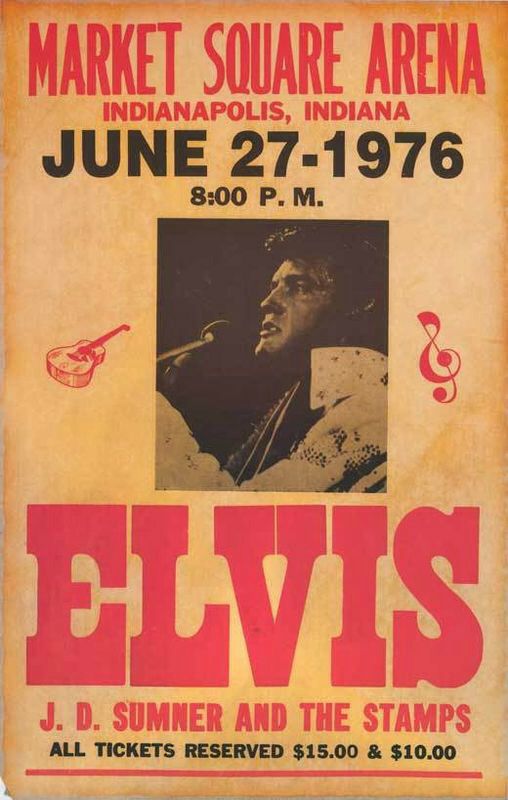
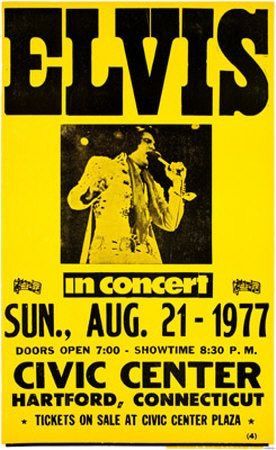
As the review observed, Elvis’ fluctuating weight was an ongoing theme in the press, and the souvenir photos being hawked at the arena were of a ‘younger Elvis’. It’s interesting to note that pre-show publicity from around this period also used images from earlier in the 1970s, as shown in these examples below. (The Hartford show was to be part of the tour beginning on August 17th, 1977).
Anthony Rocha had sole credit for the second review, thought the May 3rd show was better, and had something to say about the Elvis phenomenon more generally.
“…. Elvis Presley is a successful practitioner of maintaining his total appeal despite the passing years and excess weight…The gathering of young and not so young in sharing the Presley experience appeared to prefer the form rather than the substance…For most of the people who saw Presley during his appearances, the memory and experience of the show made the effort to attend worth it. The larger question for Presley and his management is whether sacrificing his self-imposed solitary existence can continue in the push for profits. Presley’s contact with the real world by a visit to the small markets might prove to him that maintaining his legend is not worth the price of loneliness he has paid over the years…”
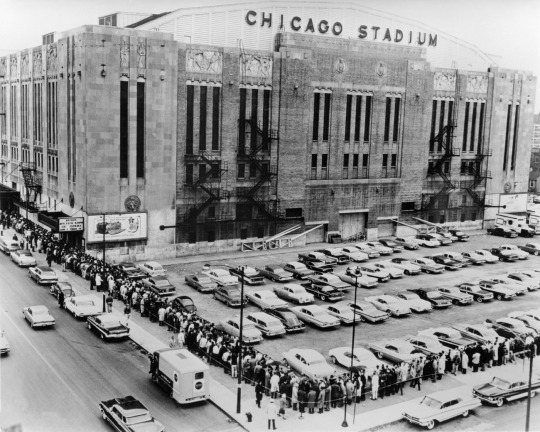
The reference to playing the ‘small markets’ merits deeper analysis by looking at some wider attendance stats for additional context; the smallest house around this period was on February 13th in West Palm Beach, Florida, sold out at 5 981. As a counterpoint, however, it’s worth noting that Elvis played two shows at Chicago Stadium (20 000 per show) during this tour, and had played there twice in October 1976. Other sizeable venues include, Largo Capital Center, Maryland (19 000), Kemper Arena, Kansas City (17 000), Philadelphia Spectrum (18 800), Riverfront Coliseum, Cincinnati (16 795), Market Square Arena, Indianapolis, (18 000) and numerous other arenas seating between 10 000 and 17 000, almost all of which were sold out or near enough.
It’s abundantly clear that fans in the ‘small markets’ were ecstatic when Elvis came to town, and most of the time Elvis himself thrived on the interaction, but the heavy touring schedule was undoubtedly taking its toll on his faltering health and wellbeing, and on some nights, this reflected in the quality of his performance. There is a tendency to lay the blame for this increasingly impossible situation on Colonel Parker; in fact, during this tour Parker was forced to publicly deny press rumours that he was selling Elvis’ contract to a business consortium to cover gambling debts. (We go into this in more detail in our episode on Elvis’ show in St Paul, Minnesota). But the financial imperative to keep working was just as critical for Elvis himself, as royalties from record sales were nowhere near sufficient to fund his personal responsibilities, business expenses and lifestyle.
The joyous night that we’re celebrating here, April 25th in Saginaw, showed what Elvis was still capable of even at this late stage, and his efforts were justly rewarded by a loud, enthusiastic and very appreciative audience. But, as Gary reminds us, his natural ability to put on a great show shouldn’t blind us to the personal struggles he was confronting at the time. The sobering reality is that he had less than four months to live.
Peter Guralnick, in his definitive biography, Careless Love: The Unmaking of Elvis Presley, was quite harsh about the general quality of Elvis’ performance during this period (perhaps unfairly in places), but did concede that there were some shows that reminded everyone of how it was, and perhaps could be again. This was very probably one of those nights.
Very special thanks to Gary Wells, Francesc Lopez, and to all our readers and listeners.
Additional Context and Notes

An Interview with Francesc Lopez: Founding webmaster of elvisconcerts.com (Internal link)
Tony Brown’s standard piano solo and the original version of Two Mile Pike by Barefoot Jerry
Gary Wells: Blue Hawaii Scene by Scene
Related Content: Elvis in the ’70s (Internal link)
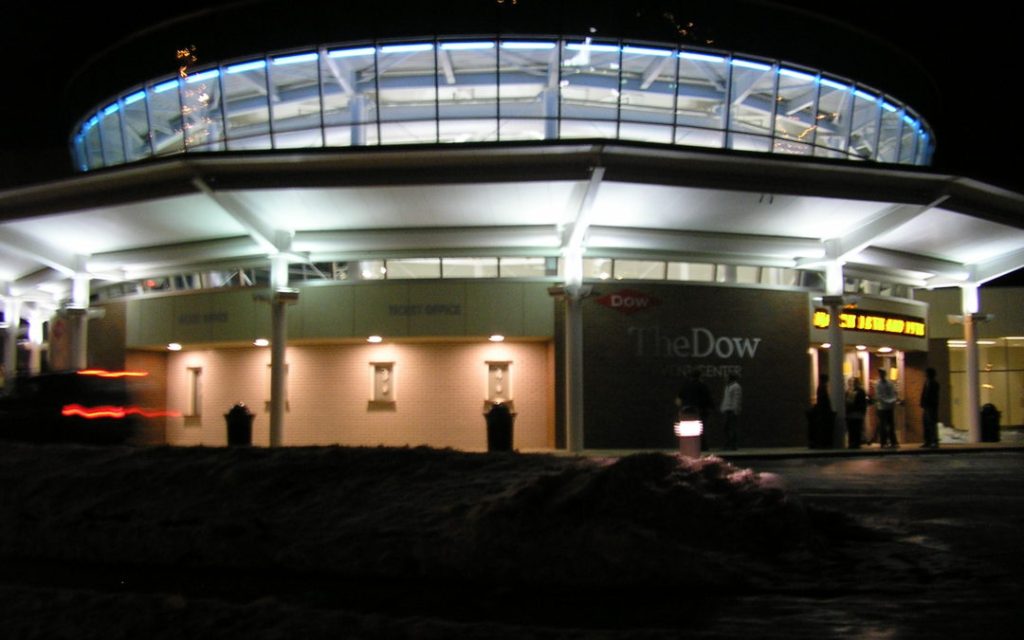
The Dow Event Center (Formerly Saginaw Civic Center / Wendler Arena)
Please help us to maintain our page quality by reporting any malfunctioning or redundant links.
 The DEC4 Podcast by George Fairbrother
Thank you all for the congratulations and for the pronunciation of my name. I would like to comment that Elvis often played in smaller markets because they could request fee discounts for the venues. Some newspaper reviews indicated that the Elvis organization asked to lower the venue fee for a fixed amount or a reduced percentage. Oklahoma City in 1973 was one such case. They didn’t mind because the gross amount was higher than for other artists, since Elvis tickets were priced higher than those for any other concerts. Thanks for the report about Saginaw.
LikeLiked by 1 person
Thanks for commenting, Francesc, and thank you for that additional context regarding the selection of venues. We couldn’t do this without you, so please feel free to weigh in at any time.
LikeLike